IT Governance for Small Businesses: What It Actually Does (And Why It Matters)
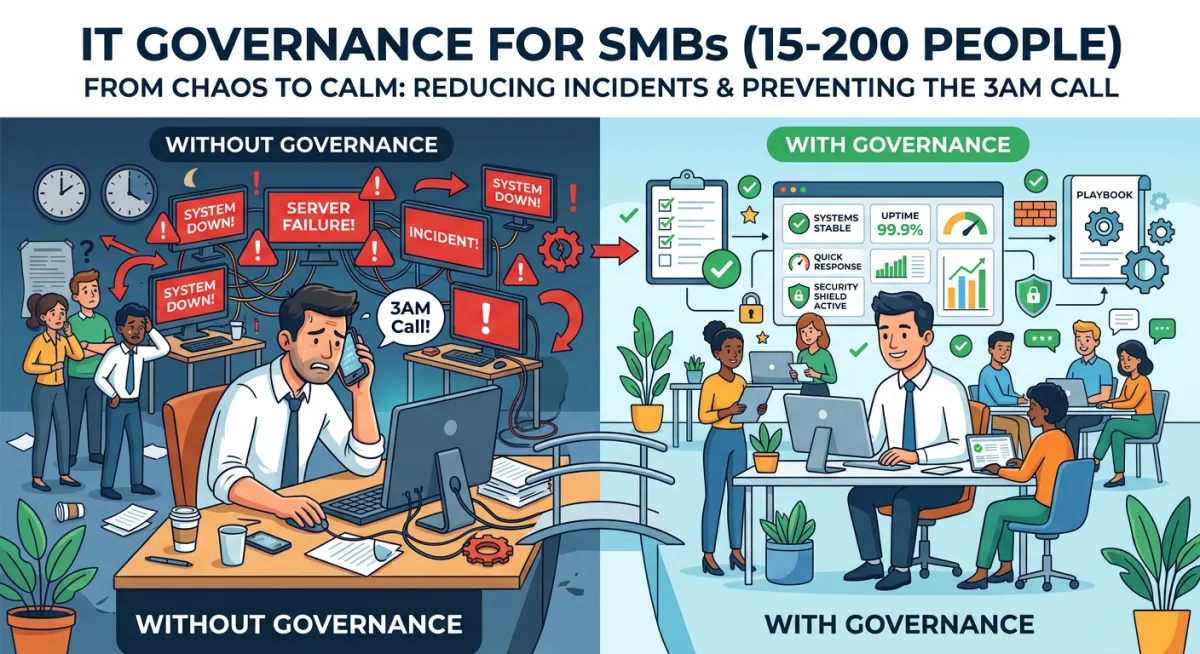
IT Governance Isn't Boring. It's the Thing That Stops 3 am Calls.
When most people hear "IT governance," they picture something specific.
Long policy documents. Compliance checklists. Audit trails. Meetings where frameworks get discussed and diagrams get drawn and very little seems to change in the actual day-to-day running of the technology.
I understand why it has that reputation. I've been in those meetings. I've seen governance treated as a bureaucratic exercise - something done for auditors rather than for the organisation. And I'll be honest: governance done badly is exactly as tedious and ineffective as its critics suggest.
But governance done well is something completely different. And in my experience, the companies that have invested in doing it well are the ones whose 3 am calls are shorter, less frequent, and less damaging than their peers.
Before I get into what good governance looks like, I want to say something that I say to every organisation I work with. Governance is not a tool. And I'll explain why that distinction matters more than it might seem.
Process Before Tooling - Always
There is a pattern I've watched play out many times. A company decides to get serious about incident management and their resiliance. They evaluate tools - change management platforms, ITSM systems, and incident tracking software. They pick one. They implement it. Six months later, the same incidents are happening at the same frequency.
The tool wasn't the problem. The absence of a clear process was the problem. And a tool bolted onto an unclear process doesn't clarify the process - it just makes the confusion faster and more expensive.
I raise this here because governance is the process layer that makes any tool investment worthwhile. If you're thinking about investing in an ITSM platform, a change management system, or an incident tracking tool - the questions governance answers are the questions the tool will assume you've already answered. Who owns this system? What approvals are required before a change goes to production? What is the escalation path when something breaks? Who decides whether this is a P1? Is it Incident commander / incident manager or someone else? What happens if you nurture devops culture, who is in charge?
If those questions don't have agreed, documented answers before you select a tool, the tool selection will be based on the wrong criteria. You'll end up with a sophisticated platform that doesn't match your actual process - because your actual process was never defined.
Governance first. Tooling second. In that order, every time.
What IT Governance Is Actually For
Let me offer a different definition than the one most people are working with.
IT governance is the set of decisions, processes, and accountabilities that determine how your technology environment is managed, changed, and protected - and what happens when something goes wrong.
Put that way, it's not about paperwork. It's about clarity. Who decides what? How do changes get made safely? What does the escalation path look like? Who owns which system? What is the recovery process when something breaks or when an incident happens? What information goes to which stakeholder and when?
All of those questions have answers in every organisation. In organisations without governance, those answers live in people's heads, vary depending on who you ask, and are discovered reactively during incidents. In organisations with governance, those answers are documented, agreed, and available to whoever needs them — including, critically, whoever is on-call at 3 am.
The 3 am call is shorter when the person who receives it knows exactly what to do, who to escalate to, and what the documented process says. It's longer - sometimes much longer - when they're working it out as they go.
The Three Things IT Governance Prevents
In my experience, good IT governance for small businesses directly prevents three categories of incident cost that are otherwise almost inevitable.
The undocumented change that breaks things. A significant proportion of IT incidents are caused by changes - updates, configurations, deployments - that were made without adequate testing, review, or documentation. Change management, as a governance practice, doesn't eliminate the risk that changes will cause incidents. It reduces it significantly by requiring that changes be planned, reviewed, and reversible.
The incident escalated because nobody knew who to call. Without a documented escalation path, every major incident involves a period of improvised decision-making about who should be involved and who has authority to make which calls. That period costs time - sometimes a lot of it. A governance framework that defines escalation paths in advance eliminates that cost. When the incident happens, everyone knows the path. Nobody is making it up under pressure.
The recurring incident that was never properly closed. Problem management - tracking the root causes of incidents and ensuring they are addressed - is what turns a post-mortem from a documentation exercise into a prevention mechanism. Without it, incidents recur. With it, there is a formal accountability structure for ensuring that identified root causes are actually resolved, not just acknowledged.
The Prevention Value Nobody Calculates
Here is a question I ask organisations that are sceptical about investing in governance: what did your last three major incidents cost you?
Not the visible cost - the staff hours and the lost revenue. The full cost. The management time, the client relationship damage, the follow-on incidents, the engineer burnout from repeated firefighting.
Now compare that to the cost of building the governance structures that would have prevented or significantly reduced those incidents.
In almost every case I've seen, the prevention investment is a fraction of the incident cost. Not because governance is cheap - it requires time, commitment, and leadership buy-in. But because the incidents it prevents are expensive in ways that compound over time.
The problem is that prevention is invisible. When governance is working, incidents don't happen - or happen less often, or are resolved faster, or cause less damage. None of that shows up on a dashboard. The 3 am call that didn't happen is not a metric. The client relationship that stayed intact because the incident communication was structured is not a line item.
The incidents that do happen, on the other hand, are very visible. And very measurable. But by then, the investment case has already proved itself in the most expensive possible way.
What IT Governance Looks Like for a Company of 15 to 200 People
I want to be specific here, because IT governance frameworks can be intimidating at scale and the instinct is often to assume they're designed for enterprise organisations with dedicated compliance teams.
They're not. And for a company of your size, you don't need the full enterprise implementation of ITIL or COBIT. What you need is the core of it - the parts that directly reduce your incident risk and improve your recovery capability.
That means: a change management process that requires review before significant changes go to production. An escalation matrix that everyone in the team has seen and knows how to use. A documented on-call process that is specific enough to be followed by someone who has never handled this type of incident before. A problem management practice that tracks root causes and ensures actions are completed — not just assigned.
None of that requires a governance team. It requires a leadership decision that these practices matter enough to build and maintain. And it requires someone to own them - not as a bureaucratic function, but as a genuine operational responsibility.
Once you have this process clarity, you'll also find that any tool you choose - whether that's a lightweight ITSM platform, an on-call scheduling tool, or a full incident management suite - will work far better than it would have without it. The tool serves the process. Not the other way around.
The Honest Caveat
I said earlier that governance done badly is exactly as useless as its critics suggest. I want to stay true to that.
Governance for its own sake - policies written to satisfy an auditor, processes designed around the framework rather than around the actual work - is a waste of time and creates resentment in the people who have to follow it without understanding why.
The question to ask about every governance practice is: what incident does this prevent, or what response does this improve? If you can't answer that question, the practice probably needs to be redesigned. If you can answer it clearly, the practice is worth building and maintaining - regardless of what the framework document says.
Governance that is connected to operational reality protects your team, your clients, and your business. Governance that is disconnected from it protects nobody.
Frequently Asked Questions
What is IT governance and why does it matter for small businesses?
IT governance is the set of decisions, processes, and accountabilities that define how technology is managed, changed, and protected. For small businesses, it matters because without it, incident response becomes improvised - costing more time, more money, and more relationship damage than a basic governance structure would have required.
Should I implement an IT governance process before choosing an incident management tool?
Yes - and this is one of the most consistently overlooked sequencing mistakes in IT management. Tools like PagerDuty, Opsgenie, or ServiceNow assume you already know your escalation paths, severity levels, on-call roles, and change approval processes. Without that clarity, tool selection is based on the wrong criteria. Define the process first, then choose the tool that serves it.
Do small companies need a full ITIL or COBIT implementation?
No. For companies of 15–200 people, the goal is to apply the relevant parts of these frameworks - change management, escalation paths, problem management — without the full enterprise overhead. The principles scale; the bureaucracy doesn't have to.
What is the most important IT governance practice for incident prevention?
Change management - ensuring that significant changes to production systems go through a documented review and approval process - is consistently the highest-impact governance practice for reducing incident frequency. The majority of IT incidents are triggered by uncontrolled or undocumented changes.
How do I build an IT governance framework without a dedicated team?
Start with the three core practices: a change review process, a documented escalation matrix, and a problem management log that tracks open root causes. Assign ownership of each to a named person - not a team or a role, a specific individual. Review quarterly and adjust as the team and systems evolve.